Pain is inevitable. Suffering is optional: Murakami on Running

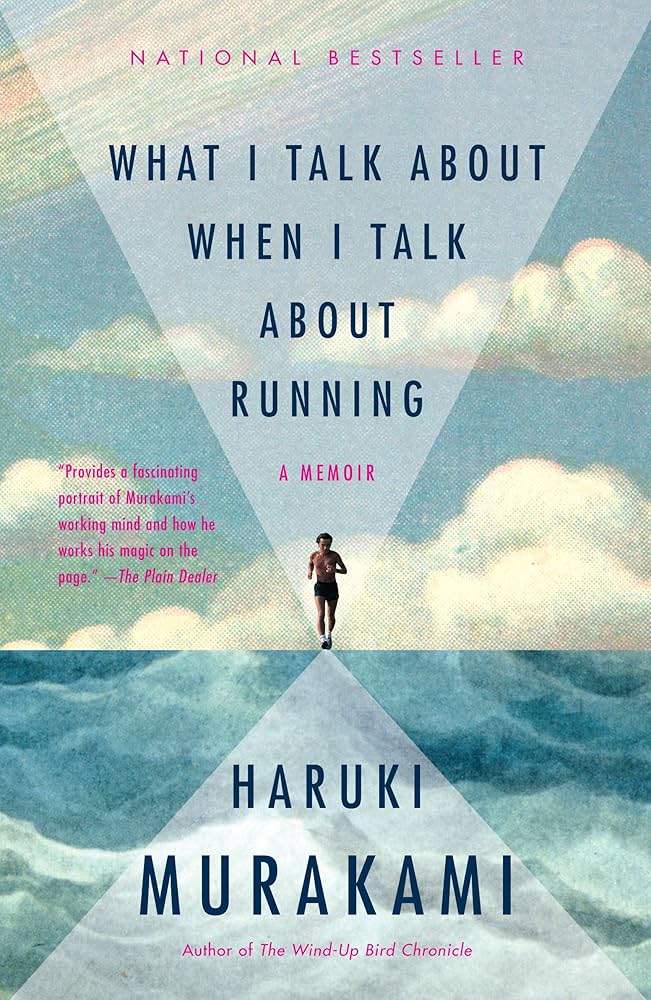
I just finished Haruki Murakami’s memoir-ish writing/running book What I Talk About When I Talk About Running and I think it’s the clearest and most concise writing I’ve read about what it feels like to run. Picking this book up coincided with an attempt to ease back into running after a long, multi-year, pause. Somehow, during the endless Zoom meeting filled months of the pandemic, I fell off my habit of running two or three days a week. I’m not sure why. Maybe lingering knee pain. Maybe just a general malaise. I don’t know if my return to running will stick (I’m really just slow speed shuffling with alternating walk breaks–I recommend something like this app if you’re just beginning or coming back from a break). Perhaps the knee pain will return and I’ll have to take up swimming which, just like Murakami, I’m terrible at.

Murakami’s straightforward honesty got me hooked. This particular passage, his response to what he thinks about when he runs, rang true,

As I run I tell myself to think of a river. And clouds. But essentially I’m not thinking of a thing. All I do is keep on running in my own cozy, homemade void, my own nostalgic silence. And this is a pretty wonderful thing. No matter what anybody else says.

It’s funny that I’ve never thought about this question, but I realized I have the same experience as Murakami. I don’t think about much of anything while I’m running. Like him, I put on some music and just run. Sometimes a vague idea will pop in my head but, as Murakami says, “I run in order to acquire a void”. For me running lets me escape the constant chatter and overthinking I’m prone to. It clears that clutter and, in my experience, uplifts my mood for the rest of the day.

This wasn’t always the case for me. I discovered running sometime in my late 20s and hated sports and physical education in school. With a few notable exceptions, in my experience, the very worst teachers were in charge of PE. Running was often meted out as punishment, a practice that really needs to stop. Murakami says,

Whenever I see students in gym class all made to run a long distance, I feel sorry for them. Forcing people who have no desire to run, or who aren’t physically fit enough, is a kind of pointless torture. I always want to advise teachers not to force all junior and senior high school students to run the same course, but I doubt anybody’s going to listen to me. That’s what schools are like. The most important thing we ever learn at school is the fact that the most important things can’t be learned at school.

Running is a divisive subject. Some love it and some really hate it. There doesn’t seem to be many people between these two poles, though many people force themselves to run. I have no idea if non-runners will enjoy Murakami’s book but its wisdom extends far beyond the usual feel good article in a running magazine and could also be read as a book about writing.

Murarkami is in much better shape than I ever was. He can run for miles every day. I can only run, at most, every other day and I have to do considerable work at the gym to prevent injuries. And I’ve had many injuries. These injuries have taught me to, as I think of it, “look above the problem.” If you have foot pain it often involves the calve. Knee pain involves the hips. You can keep going up the body until you reach the seat of consciousness itself and therein, running can teach us life lessons, not the facile life lessons found in airport self help books, but something deeper. Here’s a few I underlined:

“Pain is inevitable. Suffering is optional”

“I don’t think we should judge the value of our lives by how efficient they are.”

“If I’m asked what the next most important quality is for a novelist, that’s easy too: focus—the ability to concentrate all your limited talents on whatever’s critical at the moment.”

“No matter how long you stand there examining yourself naked before a mirror, you’ll never see reflected what’s inside.”

I may be counting my chicks before they’ve hatched. I’ve only been back to running for a month and I know, all to well, how easy it is to push too hard and end up with an injury that can take a very long time to recover from and, at this point, might end my running for good. Like Murakami I have to accept the inevitability that my running days will draw to a close someday. But until that time I hope to enjoy the great clearing of the mind that running provides.

Hot Colonoscopy Summer

I was binging the Garden Fork podcast and the host Eric mentioned the importance of colonoscopies. In August, I had one and the doctor asked me, as I left, to promise to tell everyone I know about the importance of this procedure. So here we go.

Yes, it takes a day and a half away from your schedule and the procedure is the butt (haha) of puns, old person humor and scatological jokes. A neighbor, in fact, told a fantastic joke that I can’t repeat here, unfortunately.

Far more important than your future stand up routine at the Burbank Flappers, however, is the fact that a colonoscopy can prevent some terrible cancers that the home test kits can’t detect. Both times I’ve had a colonoscopy the doctor found and removed polyps. The gunk you have to drink and the time by the toilet during the prep time is a small price to pay for the peace of mind you get once you’ve checked off this important task.  If your doctor wants you to get one make that appointment today.

Whacked the President with a Single Stick

A forgotten and dangerous cousin to modern day fencing, single stick fighting involves a short and inflexible piece of wood. Ouch. Early 20th century notions of physical therapy were obviously different than today as evidenced by President Theodore Roosevelt using single stick fighting as a way to recover from a carriage accident. Here’s how the New York Times covered his unusual PT sessions:

WHACKED THE PRESIDENT WITH A SINGLE STICK

Gen. Wood Raised a Lump on Mr. Roosevelt’s Forehead

Special to the New York Times.

WASHINGTON, Dec. 29–President Roosevelt has not been wounded in the forehead with a rapier wielded by Gen. Wood, nor has he been swinging a broad sword at that officer, as reported in New York today; but he has been whacking his military friend over the head with a single-stick, and Gen. Wood has been returning the compliment. As a result the President is wearing a bruise on his forehead just over the left eye.

For the last month the President and Gen. Wood have been accustomed to repair daily, or almost daily, to a room in the White House where they are free from interruption and have a bout at single-stick. This ancient English exercise used to have as its point the drawing of blood. Neither the ex-Colonel nor the ex-Lieutenant Colonel of the Rough Riders has aimed a making this point, but both havve confined themselves to developing their skill with the weapon and getting as much exercise and fun out of the game as possible.

Notwithstanding this, it is impossible to play with single-sticks without occasionally getting hurt, and both the President and his ex-superior officer have daily given and received some pretty severe raps. Lumps have appeared at frequent intervals on the head of each. The one which the President received the other day, however, was worse than usual and more visible to the casual observer. As a result the wildest kind of rumors were started, finally culminating in the broadsword and rapier story. This led to the discovery of the secret which the President and his friend have guarded so successfully for a month or more.

The PT must of worked since, ten years later, not letting an assassination attempt get in the way, Roosevelt was able to deliver a 90 minute speech after being shot in the chest.

Getting Online Hearing Aids

SilverDia2_CMYK_1024x1024I was born with crappy hearing. High frequencies such as high pitched bird calls and bleeping electronic devices run above my hearing range. Worse, I will often confuse “s” sounds with “t” sounds thus turning my perception of ordinary conversations into a never ending avant-garde poetry reading.

Good hearing is part of a good life. Friends and relatives get frustrated when they have to yell or repeat things. And there’s research indicating that hearing problems can contribute to dementia later in life.

Generally I’m not a fan of Silicon Valley’s “disruption” tactics, but if ever there was an industry that needed shaking up it was the hearing aid biz. Until just a few years ago hearing aids were expensive, costing thousands of dollars each for a device that’s far simpler than our much cheaper smart phones. For most people in the U.S., insurance won’t pay for hearing aids.

When I first got a hearing aid ten years ago from HearX, at $2,000 per ear, I could only afford one. It’s an outrageous price since, according to the New York Times, the device probably costs around $100 to manufacture. It’s just a microphone and speaker with a modest amount of signal processing. The computer on which I’m typing out this blog post also has a speaker, a microphone and much more sophisticated audio signal processing capabilities. It can also play cute cat videos and costs half as much as one hearing aid. And why, if I just went to my doctor for a hearing test, am I paying for someone at HearX to do the exact same test?

When it came time to replace the overpriced hearing aid which HearX would no longer service, I checked out Costco. Their hearing aids were half the price of HearX but they still made you go through another hearing test. A friend (annoyed with my bad hearing) sent me an article on new online hearing aid services and I discovered that they were half the price of Costco at around $500 to $600 an ear. I ended up going with Audicus and I’ve been pleased with the two hearing aids I purchased. I went to my doctor and got a hearing test (she also did an MRI to make sure that there was not something else going on). I sent the hearing aid test to Audicus and a week later they sent me a box with two hearing aids.

With my Audicus hearing aids the part that goes in the ear is a one-size-fits-all plug as opposed to the custom earmolds used by HearX. This cuts down on costs and means that you don’t have to go in for a fitting. I haven’t noticed any significant difference in terms of audio quality or comfort between my Audicus hearing aids and my HearX hearing aid. I’ve been using my Audicus hearing aids for two years with no problems.

I have a few important tips if you’re considering a hearing aid:

  • When I first got hearing aids a friend who is an audiologist told me to wear them all day everyday even if I was alone. This is because they take awhile to get used to. For me I was hearing sounds I had never heard before some of which were unpleasant.
  • Even when you get past the early phase you should still wear them as much as possible. I’ve been bad about this lately. It’s important to remember how important communication is for ourselves and for our relationships.
  • And don’t worry about aesthetics. Hardly anyone will notice that you are wearing them. People don’t look at your ears when they are talking to you they look at your eyes. I went with the silver colored mode above rather than a flesh colored hearing aid.

On the Vulnerabilities of Combination Locks

IMG_2013

Back in December, just a few days after Kelly came home from the hospital, I went to the gym for a badly needed workout. I put my wallet and car keys in a small set of lockers located on the weight room floor. Those lockers (pictured above) have a built-in combo lock where you can set the combo yourself. Unfortunately something went wrong. When I went back to retrieve my belongings the combo I had set did not work. I asked a staff member to find the master key to open the locker. He informed me that the boss had it and that he wouldn’t be back until after the holidays. I panicked. How would I get by without my keys, credit card and driver’s license? Then I remembered an idle afternoon back in the summer when I attempted to learn how to crack combo locks.

The efforts of that afternoon paid off. After around five minutes of practice on the other lockers I figured out how to open the lock and I manged to retrieve my belongings.

Combo locks all work the same way. The internal mechanism has three or four wheels that must align to open the lock. More expensive combo locks have false gates to make them harder to crack. The cheap built-in locks at the gym had no false gates. Opening the lock was as easy as turning the numbers until I felt a subtle resistance. The process reminded me of playing a musical instrument. All it takes is a little finger dexterity and practice.

Should you find yourself in a similar situation, you’ve got a couple of options for opening a combo lock:

  • With a shim:

  • With some math:

Both the shim and the “math” methods take practice. I have not been able to open the lock I’ve been practicing on with either of these techniques. Of course, the easiest method is just to pry open a locker with a screwdriver or crowbar. And many locks can also be defeated by drilling them.

Lastly, let’s say you have an open combo lock but have forgotten the combo. You can figure it out by peering into the opening:

In addition to adding a James Bond villain skill to your mental toolkit, consider this post as a warning. Don’t leave valuables in a gym locker. I could have easily opened the other lockers, pulled out wallets, copied down credit card numbers and put the wallets back. My fellow gym goers would not have known anything was wrong until their credit card bills arrived.